

Your smile can play an important role in how you feel about your appearance. Missing teeth can affect more than confidence—they can also make eating more difficult and may affect your oral health over time.
For patients looking for a long-term way to replace missing teeth, dental implants may be an option. Dental implants are designed to replace missing teeth with restorations that look and function much like natural teeth.
How Do Dental Implants Replace Missing Teeth?
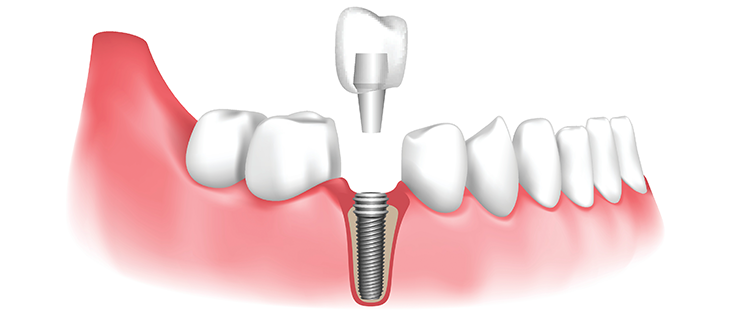
A dental implant is a small post, typically made of titanium, that is surgically placed into the jawbone to replace the root of a missing tooth.
After placement, the implant is given time to integrate with the surrounding bone. Once it has healed sufficiently, an abutment and dental crown can be attached to create the visible replacement tooth.
Depending on the patient’s needs, implants can be used to replace a single missing tooth, multiple teeth, or to help support certain types of dentures.
Unlike a traditional bridge, replacing a single tooth with an implant generally does not require preparing the neighboring teeth for crowns.
Who May Be a Candidate for Dental Implants?
Not everyone with a missing tooth automatically needs an implant. The appropriate treatment depends on your oral health, bone structure, medical history, the location of the missing tooth and your individual goals.
There are several situations in which your dentist may discuss dental implants as a treatment option.
One or More Missing Teeth
If you are missing a tooth, an implant may be used to fill the space without relying on the adjacent teeth for support.
Replacing missing teeth can restore chewing function and help prevent neighboring teeth from shifting into the open space.
Loose or Uncomfortable Dentures
Traditional removable dentures work well for many patients, but some people have difficulty with movement or stability.
In appropriate cases, dental implants can be used to provide additional support for a denture. Implant-supported options may provide greater stability while eating and speaking.
A Tooth That Cannot Be Saved
Sometimes a tooth is damaged by severe decay, fracture, infection or other problems to the point that predictable restoration is no longer possible.
If the tooth needs to be extracted, a dental implant may be one option for replacing it. However, extraction and implant placement are not always performed at the same appointment. The timing depends on the condition of the tooth, bone and surrounding tissues.
Bone Loss After Missing Teeth
The roots of natural teeth transmit forces to the jawbone during normal function. After a tooth is lost, the bone in that area can gradually change over time.
Because an implant is placed in the jawbone, it can help preserve bone in the area where it is functioning. However, patients who have already experienced significant bone loss may require additional procedures, such as bone grafting, before implant placement.
Are Dental Implants Right for Everyone?
Dental implants have a strong history of successful use, but they aren’t necessarily the right choice for every patient.
Your dentist will need to evaluate the health of your gums, the amount and quality of available bone, your bite, medical history and other factors. Smoking, uncontrolled medical conditions and active periodontal disease may also affect treatment planning and healing.
In some cases, a bridge, partial denture or another restorative option may be more appropriate.
That’s why the first step isn’t deciding that you need an implant—it’s determining why the tooth is missing or needs to be removed and which replacement option makes the most sense for you.
Considering Dental Implants?
At Rapha Dental, Dr. Mark Huh provides comprehensive restorative and implant dentistry in Cinnaminson, New Jersey and he is an associate fellow of American Academy of Implant Dentistry. We evaluate each patient’s individual situation and discuss the available options before recommending treatment.
If you have a missing tooth, uncomfortable denture or a tooth that may not be restorable, you can learn more about our dental implant services or contact Rapha Dental to schedule an evaluation.