

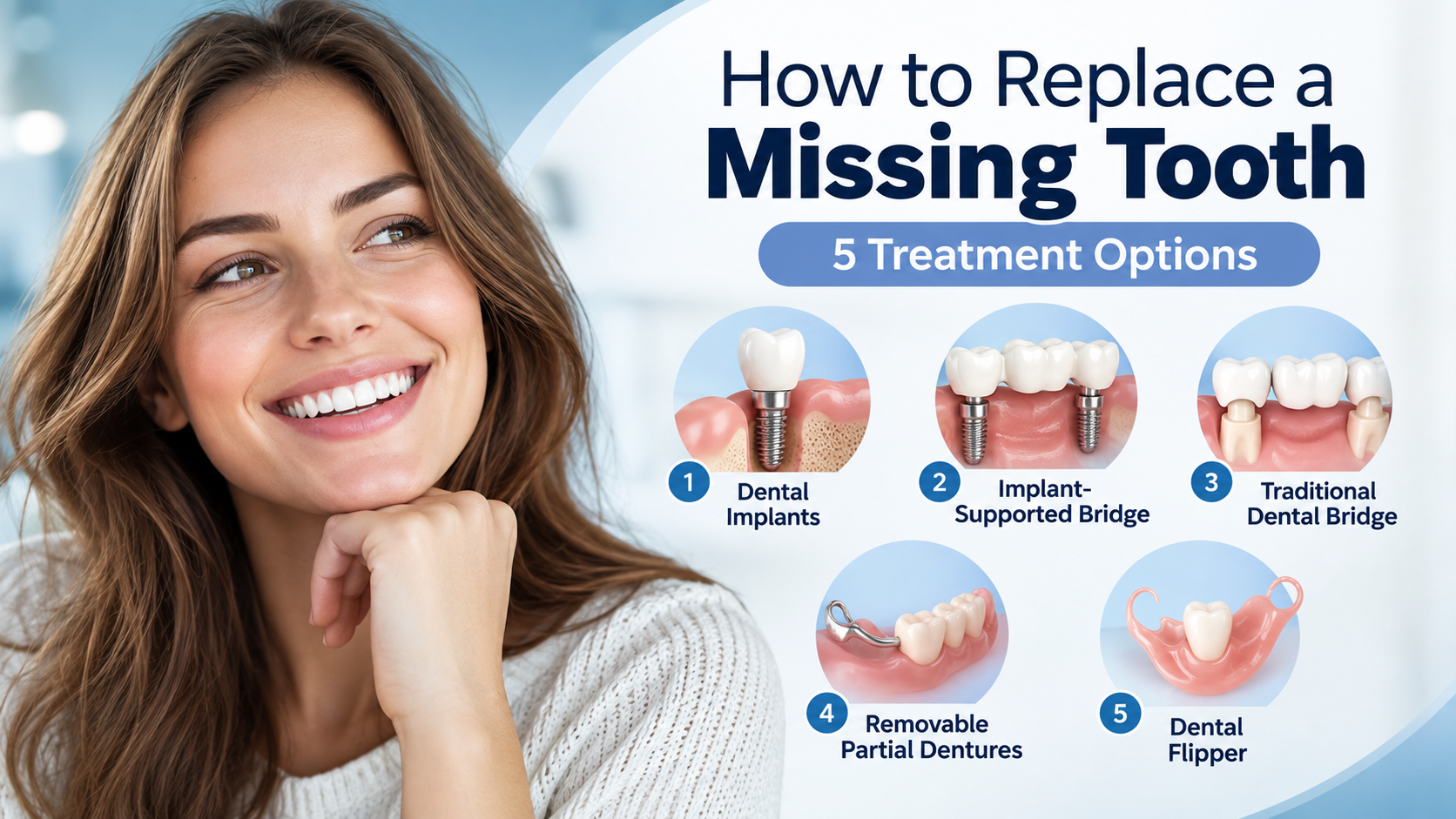
How to Replace a Missing Tooth: 5 Treatment Options
Losing a tooth can affect more than just your smile. A missing tooth may make chewing more difficult, affect your speech, and reduce your confidence. Over time, neighboring teeth may also shift into the empty space, potentially creating additional dental problems.
Whether you’ve lost a tooth because of an injury, severe decay, or gum disease, several effective treatments can restore your smile and oral function.
If you’re wondering how to replace a missing tooth, understanding the available options can help you make an informed decision with your dentist.
1. Dental Implants
Dental implants are among the most durable and natural-looking options for replacing a missing tooth.
A dental implant consists of a titanium or other biocompatible post surgically placed into the jawbone. Once the implant integrates with the surrounding bone, a custom dental crown is attached to restore the appearance and function of the missing tooth.
Benefits of dental implants:
- Look and function similarly to natural teeth.
- Help preserve jawbone by providing stimulation during chewing.
- Do not require grinding down neighboring healthy teeth.
- Can last for many years with proper care and maintenance.
However, dental implants require surgery, sufficient bone support, and adequate healing time. Some patients may need additional procedures, such as bone grafting, before implant placement.
Although implants are designed to be long-lasting, they are not guaranteed to last a lifetime.
Learn more about dental implant treatment at Rapha Dental.
2. Implant-Supported Bridges
An implant-supported bridge may be recommended when several adjacent teeth are missing.
Instead of placing an individual implant for every missing tooth, your dentist may use two or more dental implants to support a bridge that replaces multiple teeth.
For example, three or four missing teeth may sometimes be replaced using a bridge supported by two implants, depending on the patient’s bone condition, bite, and treatment requirements.
Benefits of implant-supported bridges:
- Replace multiple missing teeth with fewer implants.
- Do not rely on neighboring natural teeth for support.
- Provide stable chewing function.
- Help maintain bone in areas where implants are placed.
Implant-supported bridges generally require surgery and several months of treatment, depending on healing and individual circumstances.
Like individual dental implants, these restorations require regular maintenance. The bridge may eventually need repair or replacement even when the supporting implants remain healthy.
3. Traditional Dental Bridges
A traditional dental bridge is another effective way to replace a missing tooth without implant surgery.
This restoration uses neighboring natural teeth as supports. The dentist prepares these teeth for crowns, which hold an artificial replacement tooth in the space between them.
Traditional bridges are often considered when the adjacent teeth already have large fillings or would benefit from crowns.
Benefits of traditional bridges:
- Do not require implant surgery.
- Can often be completed within a few appointments.
- Restore chewing ability and appearance.
- May have a lower initial cost than dental implants.
One disadvantage is that the supporting teeth usually need to be permanently reshaped to accommodate crowns.
Bridges also require careful cleaning underneath the artificial tooth to help prevent decay and gum disease around the supporting teeth.
With good oral hygiene and regular dental visits, a traditional bridge can provide many years of service.
4. Removable Partial Dentures
A removable partial denture replaces one or several missing teeth using artificial teeth attached to a supporting base.
Depending on the design, partial dentures may include metal clasps, flexible materials, or other attachments that help hold the appliance in place.
They are particularly useful when multiple teeth are missing or when a patient prefers a nonsurgical, more affordable option.
Benefits of removable partial dentures:
- Generally cost less initially than implants or fixed bridges.
- Can replace several missing teeth.
- Do not usually require surgery.
- Can sometimes be modified when additional teeth are lost.
However, removable partial dentures may feel less stable than fixed restorations. Some patients also need time to adjust to speaking and eating while wearing them.
Partial dentures should be removed and cleaned daily, and they are generally taken out while sleeping unless your dentist recommends otherwise.
5. Dental Flippers (Temporary Partial Dentures)
A dental flipper is a lightweight, removable appliance commonly used as a temporary replacement for one or more missing teeth.
Flippers are often made from acrylic and may be provided while a patient waits for a permanent dental implant, bridge, or another restoration.
Benefits of dental flippers:
- Relatively inexpensive.
- Can restore the appearance of a missing front tooth.
- Do not require surgery.
- May be fabricated relatively quickly.
However, flippers are not designed to provide the same long-term stability or chewing function as permanent restorations.
They can move during eating or speaking and may require adjustments for comfort.
For these reasons, dental flippers are generally recommended as temporary rather than permanent solutions.
Which Tooth Replacement Option Is Best for You?
The best way to replace a missing tooth depends on several factors, including:
- Number of missing teeth: Replacing one tooth may require a different approach than replacing several adjacent teeth.
- Jawbone health: Dental implants require adequate bone support.
- Condition of neighboring teeth: A traditional bridge may be appropriate when adjacent teeth already need crowns.
- Budget: Treatment costs vary depending on the type of restoration and complexity of the procedure.
- Personal preferences: Some patients prefer a fixed restoration, while others want to avoid surgery.
A comprehensive dental examination, including appropriate X-rays, can help determine which treatment options are suitable for your situation.
What Happens If You Don’t Replace a Missing Tooth?
Not every missing tooth requires immediate replacement, but leaving a space untreated can sometimes cause additional oral health problems.
Depending on the location of the missing tooth, potential consequences include:
- Neighboring teeth shifting or tilting into the space.
- Opposing teeth gradually moving out of position.
- Changes in chewing efficiency.
- Bone loss in the area where the tooth is missing.
- Increased difficulty maintaining proper oral hygiene.
The extent of these changes varies from person to person. Your dentist can evaluate whether replacing the tooth is necessary and how soon treatment should begin.
Restore Your Smile at Rapha Dental in Cinnaminson, NJ
If you’re missing one or more teeth, choosing the right replacement option can help restore your confidence, comfort, and oral health.
At Rapha Dental in Cinnaminson, New Jersey, we provide personalized restorative dental care, including dental implants, bridges, and removable dentures.
Our team will evaluate your oral health, explain your treatment options, and help you choose an appropriate solution based on your needs and budget.
Contact Rapha Dental today to schedule an appointment and learn more about your tooth replacement options.