

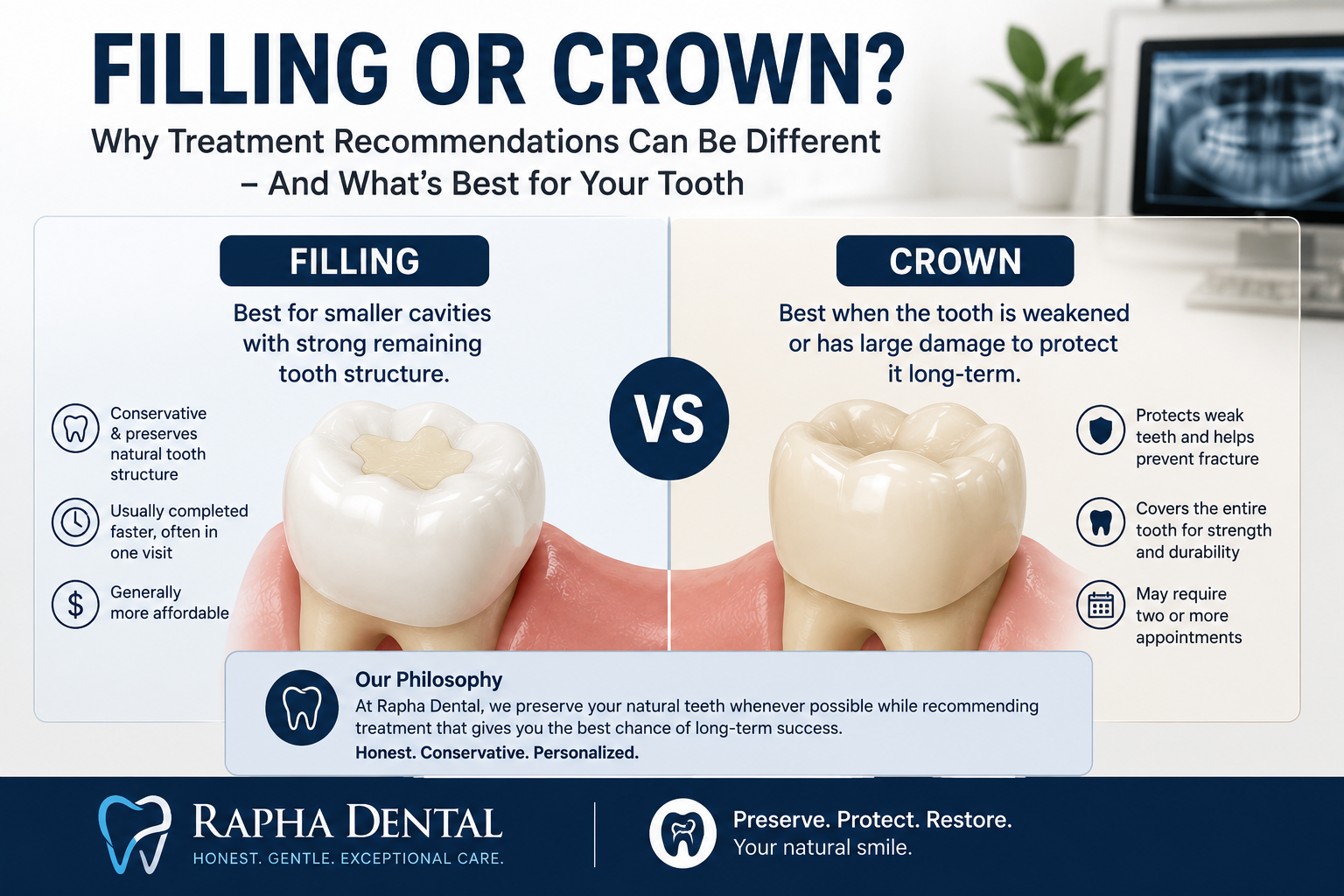
One of the most common questions I hear is:
“Another dentist told me I need a crown, but this dentist says I only need a filling. Who is right?”
Sometimes patients become frustrated because they believe the tooth could simply be “patched up” with a filling. Occasionally, patients even leave negative reviews because another office offered a filling instead of a crown.
The truth is that both dentists may be acting in your best interest.
A Filling Isn’t Always the Best Long-Term Solution
A filling replaces the portion of the tooth damaged by decay. However, as a filling becomes larger, less healthy tooth structure remains to support it.
Think of it like repairing a cracked wall. A small patch works well for minor damage, but if half the wall is missing, simply adding more patching material won’t restore its original strength.
The same principle applies to teeth.
When a cavity becomes too large, the remaining tooth can become weak and more likely to fracture during normal chewing.
Why a Crown May Be Recommended
Unlike a filling, a crown covers and protects the remaining tooth structure.
A crown may be recommended when:
- The cavity is very large.
- Most of the chewing surface has already been replaced by fillings.
- The tooth has cracked.
- The tooth has had a root canal.
- The remaining tooth structure is too weak to reliably support another filling.
Although a crown requires removing additional tooth structure, it can sometimes help prevent a catastrophic fracture that could result in losing the tooth altogether.
Why Do Dentists Sometimes Disagree?
Dentistry is not always black and white.
There are situations where both a filling and a crown are reasonable treatment options.
Every dentist has different training, experience, and philosophy.
Some dentists prefer the most conservative treatment possible.
Others recommend treatment that they believe provides the best long-term protection.
Neither approach is automatically right or wrong.
Every Patient Is Different
Dentistry is rarely one-size-fits-all. I recommend fillings every day when I believe they are the best long-term option. In many cases, a filling can successfully restore a tooth while preserving more of its natural structure.
However, when too much tooth structure has been lost, placing another large filling may increase the risk of the tooth fracturing in the future. In those situations, I may recommend a crown because my goal is not simply to repair the tooth today, but to help it remain healthy and functional for many years.
Every recommendation I make is based on the condition of the individual tooth, your oral health, your goals, and your long-term prognosis. No two patients are exactly alike, and the best treatment for one person may not be the best treatment for another.
My Philosophy at Rapha Dental
At Rapha Dental, my goal is simple:
Preserve your natural teeth whenever possible while recommending treatment that gives you the best chance of long-term success.
If I believe a filling will provide a predictable result, I’ll recommend a filling.
If I believe the tooth is at significant risk of breaking, I’ll recommend a crown—even if another office may choose differently.
Every recommendation is based on the condition of your tooth, not a one-size-fits-all rule.
When in Doubt, Ask Questions
If you’re unsure why a crown has been recommended, don’t hesitate to ask your dentist to explain the reasoning. Understanding the condition of your tooth and the pros and cons of each option can help you make an informed decision.
At Rapha Dental, we believe patients deserve clear explanations, honest recommendations, and treatment plans tailored to their individual needs.
Mark Huh DMD