

“You have a cavity.”
Most patients hear those words and assume one thing: I need a filling.
But does every cavity need a filling?
Not necessarily.
Tooth decay is not simply a matter of having a cavity or not having one. Dental caries develops along a spectrum, and some early lesions may be monitored or managed without immediately drilling into the tooth.
This is one reason you may sometimes hear your dentist say:
“Let’s watch this tooth.”
That does not mean we are ignoring the problem. It means we are evaluating where the tooth is in the decay process and whether treatment is necessary now.
Cavities Develop in Stages
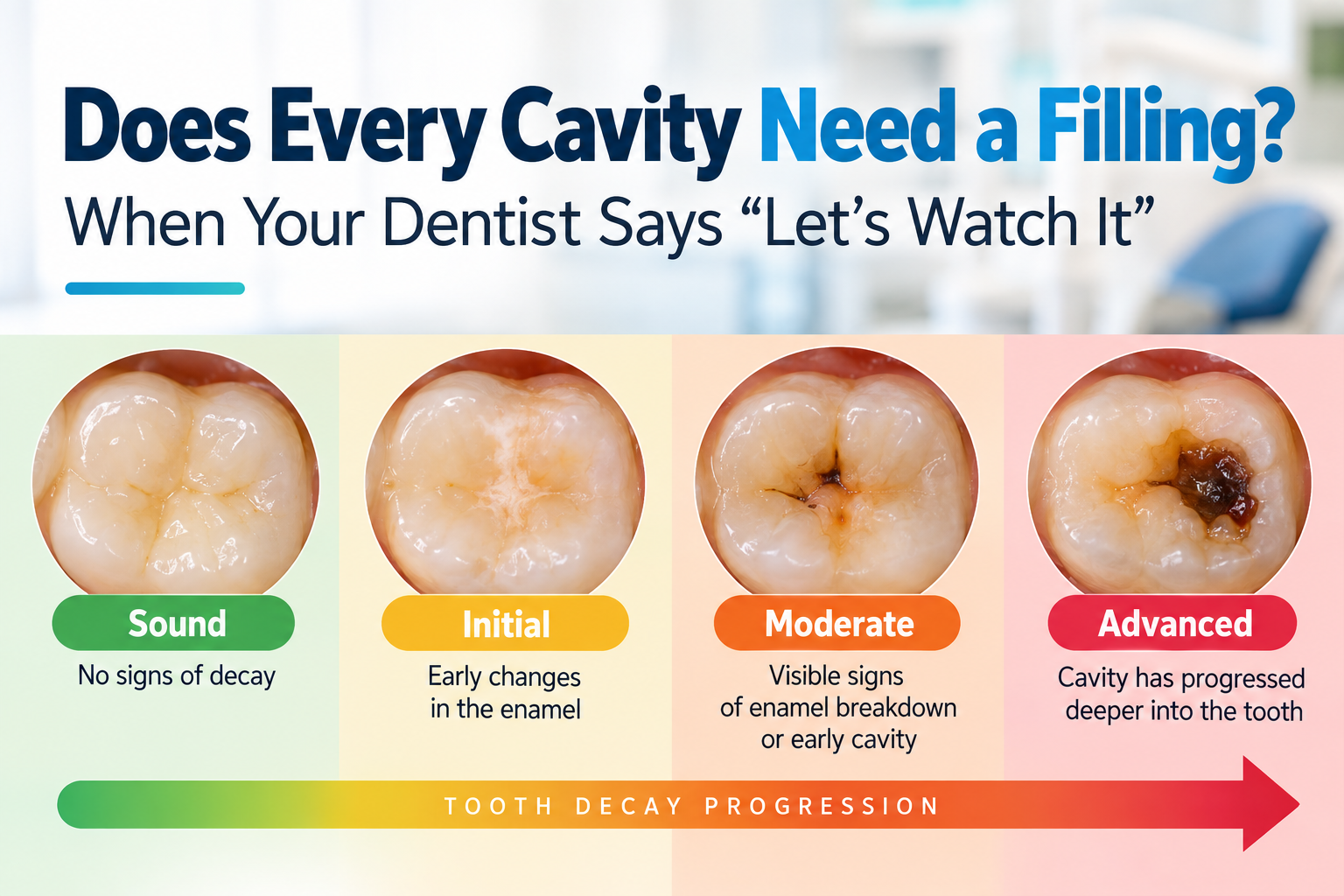
The American Dental Association Caries Classification System categorizes caries lesions as sound, initial, moderate, or advanced.
An initial lesion can represent early mineral loss in the enamel without an actual hole or cavity in the tooth.
As the process progresses, there may be visible breakdown of the enamel, involvement of the dentin underneath the enamel, and eventually deeper destruction of the tooth.
In other words, there is an important difference between early demineralization and a tooth that has already developed significant structural damage.
The ADA recognizes dental caries as a dynamic disease process involving both demineralization and remineralization. Whether a lesion progresses, stops, or potentially reverses depends on several factors. American Dental Association
When Might a Cavity Not Need a Filling?
If decay is detected at an early stage and the surface of the tooth has not cavitated, restorative treatment may not always be necessary immediately.
Depending on the tooth, location of the lesion, patient’s cavity risk, oral hygiene, diet, fluoride exposure, and other clinical findings, your dentist may recommend preventive treatment and monitoring.
This could include improved brushing and flossing, fluoride treatment, dietary changes, dental sealants in appropriate situations, and regular examinations and X-rays.
For certain noncavitated lesions, the ADA recognizes nonrestorative approaches intended to arrest or reverse the disease process. American Dental Association
What Does “Let’s Watch This Tooth” Actually Mean?
When I tell a patient that we are going to “watch” an area, I am not simply waiting for it to become a bigger cavity.
We may document the appearance of the tooth clinically and compare dental X-rays over time.
At future visits, we are asking questions such as:
Has the area changed? Has the lesion progressed farther into the tooth? Is the tooth surface still intact? Has the patient’s cavity risk changed? Are there any new symptoms?
If the area remains stable, continuing to monitor it may be appropriate.
If we see evidence that the decay is progressing, restorative treatment may become the better option.
When Is a Filling More Likely to Be Necessary?
As decay progresses and tooth structure begins to break down, simply monitoring the area becomes less appropriate.
A visible cavity, structural breakdown, progression into dentin, increasing lesion size, symptoms, or other clinical findings may change the treatment recommendation.
This is why two areas that patients casually call “cavities” may receive completely different recommendations.
One may need a filling.
Another may need to be monitored.
And another may benefit from preventive or nonrestorative treatment.
The decision should be based on the individual tooth and patient rather than treating every early sign of decay exactly the same way.
Why Not Just Fill It Before It Gets Bigger?
This is a reasonable question.
A dental filling requires removing tooth structure and replacing it with a restorative material. Once a tooth receives a restoration, that restoration may eventually require maintenance or replacement during the patient’s lifetime.
Therefore, if an early lesion can appropriately be managed without a restoration, preserving healthy natural tooth structure can be beneficial.
At the same time, waiting is not appropriate for every cavity. A lesion that is actively progressing may require treatment before substantially more tooth structure is affected.
The goal isn’t to fill every suspicious area, nor is it to avoid fillings at all costs.
The goal is to provide the appropriate treatment at the appropriate time.
Does Every Cavity Need a Filling?
No. Not every early caries lesion automatically requires a filling.
Modern dentistry recognizes tooth decay as a disease process that can range from very early mineral changes to advanced cavitation.
That is why your dentist considers the clinical examination, dental X-rays, lesion activity and progression, your individual cavity risk, and other factors before recommending treatment.
So the next time your dentist points to an area on an X-ray and says:
“Let’s watch this tooth.”
you’ll know that watching can itself be part of a deliberate treatment strategy.
At Rapha Dental, we believe in treating dental problems when treatment is appropriate while preserving healthy natural tooth structure whenever possible.
If you have questions about a cavity, an existing filling, or an area another dentist has recommended for treatment, contact Rapha Dental or request an appointment.
Sources
American Dental Association — Caries Risk Assessment and Management
American Dental Association — Nonrestorative Treatments for Carious Lesions Clinical Practice Guideline