

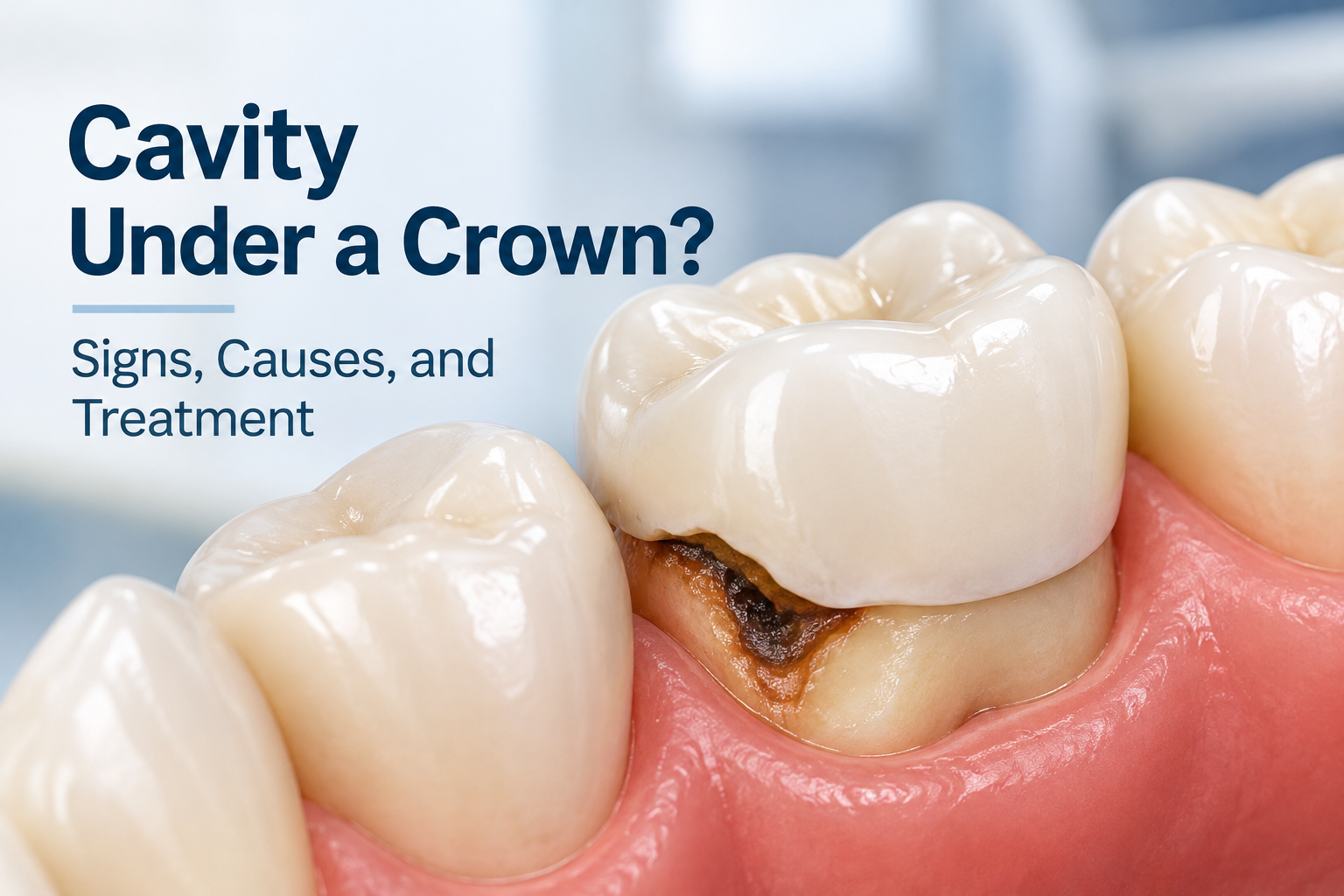
Can You Get a Cavity Under a Crown? Signs, Causes, and Treatment
Dental crowns are designed to protect and restore damaged teeth, but they don’t make the underlying tooth immune to decay. Even with a well-fitted crown, cavities can sometimes develop around its edges or underneath it.
A cavity under crown restorations is often difficult to detect without a dental examination. Understanding the warning signs, causes, and available treatments can help you protect your natural tooth and avoid more extensive dental procedures.
Can You Get a Cavity Under a Dental Crown?
Yes. Although dental crowns are typically made from durable materials such as zirconia, porcelain, or metal, the natural tooth underneath can still develop cavities.
A dental crown covers the visible portion of a tooth, but the area where the crown meets the natural tooth remains vulnerable to bacterial plaque.
If plaque accumulates around the crown margin, bacteria can produce acids that gradually damage the exposed tooth structure. This is sometimes called recurrent or secondary decay.
Over time, decay may spread beneath the crown, potentially compromising the tooth and its restoration.
What Causes a Cavity Under a Crown?
Several factors can contribute to tooth decay beneath an existing dental crown.
1. Plaque Accumulation Around the Crown
Inadequate brushing or flossing can allow plaque to collect near the gumline and crown margins. This increases the risk of decay, particularly in areas that are difficult to clean.
2. Open or Damaged Crown Margins
Over time, changes in the tooth or deterioration of the restoration can create gaps along the crown margin.
These areas may trap plaque and allow decay to develop in the exposed tooth structure.
3. Gum Recession
When gum tissue recedes, previously covered root surfaces may become exposed.
Because root surfaces are more susceptible to decay than enamel, gum recession can increase the risk of cavities near the edge of a crown.
4. Frequent Sugar Consumption
Frequent consumption of sugary foods and beverages provides fuel for cavity-causing bacteria.
Repeated acid exposure can gradually damage natural tooth structure, even when much of the tooth is covered by a crown.
5. Dry Mouth
Saliva helps neutralize acids and wash away food particles. Reduced saliva flow can increase the risk of tooth decay around crowns and other dental restorations.
Signs and Symptoms of a Cavity Under a Crown
A cavity beneath a dental crown may not cause noticeable symptoms initially.
However, possible warning signs include:
- Sensitivity to hot or cold: Discomfort when drinking cold water or hot beverages.
- Pain when chewing: Tenderness or discomfort when biting down.
- Persistent toothache: Ongoing pain around a crowned tooth.
- Bad taste or odor: Occasionally associated with trapped debris or infection.
- Visible discoloration: Dark areas near the crown margin.
- Loose crown: A crown that feels unstable or begins to move.
- Swollen gums: Inflammation around the affected tooth.
These symptoms do not necessarily indicate a cavity. Problems such as gum inflammation, a cracked tooth, or bite-related discomfort can cause similar symptoms.
Importantly, a tooth that has undergone root canal treatment may develop decay without producing typical temperature sensitivity.
A dental examination is necessary to determine the underlying cause.
How Does a Dentist Detect Decay Under a Crown?
Diagnosing decay beneath a crown can be challenging because the restoration covers much of the natural tooth.
Your dentist may use several methods to evaluate the tooth.
Clinical examination: The dentist examines the crown margins, surrounding gums, and any visible tooth structure for signs of decay or damage.
Dental X-rays: Bitewing or periapical X-rays may reveal decay near the crown margins or beneath certain areas of the restoration.
However, some crown materials can obscure portions of the underlying tooth, and early decay may not always be visible on an X-ray.
Evaluation of crown fit: Your dentist may check for open margins, looseness, or other signs that the restoration is compromised.
In some situations, removing the crown may be necessary to determine the full extent of the decay.
Can a Cavity Under a Crown Be Fixed?
Yes. In many cases, a tooth with decay beneath a crown can be treated and preserved.
The appropriate treatment depends on the location and extent of the decay, the condition of the existing crown, and how much healthy tooth structure remains.
Small Cavities Near the Crown Margin
If decay is limited to a small, accessible area near the edge of the crown, a dentist may be able to remove the decay and restore the tooth with a filling without replacing the entire crown.
However, this approach is not suitable for every case.
Removing and Replacing the Crown
When decay extends underneath the crown or compromises its margins, the crown may need to be removed.
The dentist can then remove the decay, evaluate the remaining tooth structure, and determine whether a new crown can be placed.
Root Canal Treatment
If decay reaches the dental pulp and causes irreversible inflammation or infection, root canal treatment may be necessary.
After treatment, the tooth may require a new core buildup and crown, depending on its remaining structure.
Tooth Extraction
When decay extends too deeply below the gumline or the tooth cannot be predictably restored, extraction may be necessary.
Your dentist can discuss appropriate tooth replacement options if the tooth cannot be saved.
Does a Crown Always Need to Be Replaced if There Is a Cavity?
Not necessarily.
A small cavity near an accessible crown margin may sometimes be repaired while preserving the existing restoration.
However, if decay extends significantly beneath the crown, replacing it is often necessary to remove the decay completely and establish a properly sealed restoration.
The decision depends on the clinical findings rather than the presence of a cavity alone.
How to Prevent Cavities Under Dental Crowns
Although dental crowns are durable restorations, proper oral hygiene remains essential.
To reduce the risk of decay:
- Brush twice daily with fluoride toothpaste.
- Floss or use an appropriate interdental cleaner around crowned teeth every day.
- Limit frequent sugary snacks and beverages.
- Address dry mouth if it is affecting your oral health.
- Attend regular dental examinations and professional cleanings.
- Contact your dentist if a crown becomes loose, uncomfortable, or damaged.
The American Dental Association emphasizes regular oral hygiene and preventive dental care to reduce the risk of tooth decay.
Frequently Asked Questions
Can a cavity under a crown go away on its own?
No. Once a cavity has formed, the damaged tooth structure generally requires professional treatment. Very early decay without cavitation may sometimes be managed with preventive care, depending on the clinical situation.
Can you have a cavity under a crown without pain?
Yes. Decay can develop without noticeable discomfort, especially during its early stages. Teeth that have undergone root canal treatment may also develop cavities without typical toothache symptoms.
Will an X-ray show a cavity under a crown?
Sometimes. Dental X-rays can help detect decay around crown margins, but the crown material may obscure portions of the underlying tooth. A normal-looking X-ray does not always rule out decay.
Can a dentist fix decay under a crown without removing it?
In selected cases, small areas of decay near an accessible crown margin may be treated without removing the crown. More extensive decay generally requires crown removal and further evaluation.
How long can you leave a cavity under a crown untreated?
There is no predictable safe waiting period. Untreated decay can progress and eventually lead to infection or tooth loss. If you suspect a problem with a crowned tooth, schedule a dental examination promptly.
Concerned About a Cavity Under Your Crown?
A dental crown can protect a damaged tooth for many years, but regular maintenance and examinations are still important.
If you notice discomfort, sensitivity, swelling, or changes around an existing crown, an early evaluation may help prevent more complicated treatment.
At Rapha Dental in Cinnaminson, NJ, we provide comprehensive dental examinations and restorative dentistry to help patients maintain their natural teeth.
Learn more about our dental crown and bridge services or request an appointment to have your dental concerns evaluated.